Hey baseball fans!
The 2019 MLB regular season starts today, so it's only fitting I give you five of my boldest predictions for the upcoming campaign. Remember: these predictions are bold.
Prediction #1: No National League team tops 95 wins
Generally speaking, 85 wins means a team is good, while 95 wins guarantees a division championship. Well, I'm predicting that over half of the National League finishes in between these two benchmarks. Right now, I have the Braves, Phillies, Nationals, Cubs, Cardinals, Brewers, Dodgers and Rockies fighting for Wild Card spots and division crowns, but there are way too many "what-if" scenarios in the National League that would allow me to truly predict a playoff picture. Sure, I have my rough estimates, but the NL is going to be extremely tight this year no matter what.
Prediction #2: The American League 2018 playoff teams repeat as postseason contestants in 2019
While teams moved up and down the power rankings of the NL during this past offseason, the giants of the American League just got better and increased their chances of recreating the 2018 postseason in 2019. The only difference I have is that the Yankees win the AL East, while the Red Sox get the first AL Wild Card. Otherwise, the Astros cruise to another AL West championship, the Indians again destroy a really bad division, and the A's sneak away with the second Wild Card spot for the second consecutive year. I also have the Rays and Angels giving the Wild Card teams at least a little bit of trouble.
Prediction #3: Nolan Arenado wins NL MVP
I made this prediction last year, but I'm making it again! Fresh off a new contract extension and inspired by a strong season by the Rockies last year, Arenado's time to shine is now. The modern reincarnation of Mike Schmidt will most definitely be up there amongst the leaders for home runs and RBIs, but his defensive metrics will carry him to one of baseball's most coveted awards.
Prediction #4: A big trade shakes up the postseason picture
Sure, Machado getting traded to LA last July was big, but I'm talking about "Yoenis Cespedes to the Mets in 2015" big with this prediction. This hypothetical trade will probably aid a National League team and set that team apart from the others in some capacity, whether it be on the mound or at the dish. Either way, though, it's bound to happen, seeing as how slow free agency has been the last couple of years, so players might be more inclined to request a trade.
Prediction #5: The World Series matchup: Yankees vs. Cubs
Call me a homer, but the Yankees have one of the most formidable lineups and bullpens in baseball. The starting pitching needs to prove itself, but I'm seeing a trip to the Fall Classic for the Yanks in 2019. The Cubs, meanwhile, got unlucky in last year's postseason and underachieved consequently. They're out for blood in 2019 and, ultimately, one team has to win the NL pennant, as tight as its going to be.
What do you think of my predictions? Leave your thoughts in the comments section below. Thanks for reading this post and I hope you enjoyed it. Check back soon for more of "all the buzz on what wuzz."
Thursday, March 28, 2019
Saturday, March 23, 2019
The Case for Ichiro Suzuki 3/23/19
Hey baseball fans!
Ichiro Suzuki is finally hanging up his cleats, ending a legendary baseball career which spanned almost three decades. To commemorate his career and to officially get the Ichiro Hall of Fame Hype Train started, let's talk about all of the reasons that Ichiro will end up in Cooperstown.
NPB Greatness
There's plenty of Hall of Fame precedence working for Ichiro, but let's start with the very beginning. Obviously, it's no secret that Suzuki didn't start his professional baseball career in the United States. It actually started with the Orix Blue Wave (now called the Buffaloes) of the Nippon Professional Baseball league, the Japanese equivalent of the MLB. Besides his first two seasons, which were spent in and out of the farm system of the Blue Wave, Ichiro never batted under .342 during his nine-year career in Japan, won seven Gold Gloves, and three MVP awards. Even without his Major League success, Ichiro deserves Hall of Fame consideration, as hitters such as Josh Gibson currently reside in the Hall of Fame without taking a single qualified swing for an MLB team.
The First Seattle Years
Ichiro's twelve-year stint with the Mariners from 2001-2012 was historic. He won Rookie of the Year and MVP in 2001, which had only happened once before (by Fred Lynn), set the hits record in 2004 with 262 single-season hits, and had ten 200-hit seasons, along with seven years in which he led the league in hits! The bottom line is that he was a hitting machine and had 2,244 hits in his first ten years on the Mariners, all of which were years he made the All Star Game. In addition, he was a tremendous fielder, winning ten Gold Gloves in Seattle!!
When he was traded to the Yankees in the middle of the 2012 season, Suzuki was 38 years old. Had he retired right then and there, he would've still been a Hall of Famer. Why? Well, besides the acclaim he received as a literal baseball god, Ichiro's per season averages were well above par for Hall of Fame standards. A prime example of this sort of career is Ralph Kiner, who started off his career by winning seven straight home run titles as a member of the Pirates during the late '40s and early '50s, but had to retire earlier than expected due to back problems. It took the full 15 years, but Kiner eventually got into Cooperstown via the BBWAA ballot. This is not me comparing Ichiro Suzuki to Ralph Kiner, but I do just want to show how Ichiro is a deserving Hall of Famer on so many different levels, particularly using the "per-year" discipline in this case.
3,000 Hits
Ichiro didn't need that many more Ichiro-like seasons to get to 3,000 hits after his time in Seattle, but with the Yankees and Marlins for about six years, he was more of a role player. Nonetheless, Suzuki managed to make it to 3,000 hits, which is an automatic bid into the Hall of Fame. Sure, it would be nice to not see his stats tarnished by years in which he batted south of .300, but 3,000 hits is 3,000 hits, no matter if you manage to do it in ten years or 30 years.
So, what have we learned from Ichrio Suzuki's magnificent career? The answer is simple: he's amazing. Thank you, Ichiro, for everything that you gave to the game of baseball in the US, Japan, and the world. Now, only one question remains: will he join the 100% Club? I'm sure Mo could use some company. Thanks for reading this post and I hope you enjoyed it. Check back soon for more of "all the buzz on what wuzz."
Friday, March 15, 2019
Dandy, the Short-Lived Yankees Mascot 3/15/19
Hey baseball fans!
Here's a fun fact: all but three teams in Major League Baseball have mascots! Those teams are the Dodgers, Angels, and Yankees. For the sake of this post, however, because of my allegiance to the Bronx Bombers, let's talk about the only former official Yankees mascot ever, Dandy!
Dandy was essentially a skinnier, pinstriped, mustachioed, and Yankee-colored version of the Phillie Phanatic. Not surprisingly, the designer for Dandy was actually the same company that designed the Phanatic, Acme Mascots. Dandy debuted in late-July of 1979, but was quickly put on hiatus due to All Star catcher Thurman Munson dying in a plane crash. Munson was a huge inspiration for Dandy's look, particularly regarding Dandy's mustache, so the suspension made sense. In the end, because of the lost momentum from the suspension and owner George Steinbrenner's eternal hatred of mascots, Dandy was discontinued in 1981.
Honestly, bringing back Dandy now would not only be a wonderful homage to the arguable Hall of Famer Munson, but would also be a great next step for the Yankees in attracting a younger audience. Maybe someday, the poor man's Phillie Phanatic will once again grace the concrete jungle in helping the Yankees win. But what about some alternative mascots?
Idea #1: Pigeon
Birds have been synonymous with sports team names and mascots for decades, so the bird that symbolizes New York City the best would be a perfect mascot for the Yanks.
Idea #2: Anthropomorphized Bat
This may be piggy-backing, but Mr. Met is an anthropomorphized ball, so maybe he could use a compatriot of sorts.
Idea #3: Another Muppet
Gritty, the mascot for the Flyers, is one of the most popular mascots in sports right now, so maybe the Muppet look is the way to go. If that's the case, there are tons of ways to customize a muppet, meaning that the Yanks could go in any direction they want with this idea.
What do you guys think? Should the Yankees revive Dandy? If not, should they add another mascot or none at all? Leave your thoughts in the comments section below. Thanks for reading this post and I hope you enjoyed it. Check back soon for more of "all the buzz on what wuzz."
Wednesday, March 6, 2019
Five Potential 2019 World Series Rematches/Regular Season Matchups 3/6/19
Hey baseball fans!
Yes, the title of this post is a little confusing, I know. Basically, in this post, let's discuss some 2019 interleague matchups that could reappear in the '19 World Series as World Series rematches. Quick note: the following matchups will feature non-natural rivals, so the Yankees vs. Mets matchup will not be in this post. For reference, the interleague divisional matchups for 2019 are the AL East vs. NL West, AL Central vs. NL East, and AL West vs. NL Central. Still confused? Great!
Matchup 1: Red Sox vs. Dodgers
Regular Season Series: July 12-14
World Series Matchups: 1916, 2018
The Sox and Dodgers are coming off two amazing seasons, facing off against each other in the 2018 World Series. But could they both do it all again? The only question is how the Dodgers will fare in a new NL West with Manny Machado now a member of their interstate rivals, the San Diego Padres. Speaking of which...
Matchup 2: Yankees vs. Padres
Regular Season Series: May 27-29
World Series Matchup: 1998
The 1998 World Series saw the 114-win Yankees sweep the upstart Padres for New York's 24th championship. The 2019 Yankees hope to break that win total and will most likely once again be in the 2019 postseason. The Padres, meanwhile, have the best farm system in baseball and the newly-acquired Machado. If all goes according to plan for the Friars, we could see them in the NL postseason bracket as an underdog Wild Card team.
Matchup 3: Indians vs. Braves
Regular Season Series: April 19-21
World Series Matchups: 1948, 1995
The Baby Braves and the rest of the Atlanta squad are in an extremely competitive division, thanks to the Phillies signing Bryce Harper, while the Indians have almost a 100% chance of winning the AL Central for the fourth year in a row. The two teams would most likely have very different paths to the World Series, but could both make it, nonetheless.
Matchup 4: Twins vs. Braves
Regular Season Series: August 5-7
World Series Matchups: 1991
I'm including the Braves once more because, first of all, the AL Central doesn't have many World Series contenders and, second of all, the 1991 World Series was one of the best to ever be played. It went a full seven games and featured what is, at least in my opinion, the greatest pitching performance in baseball history by Twins pitcher and Hall of Famer Jack Morris. If this World Series matchup has a pitching performance of that awesomeness again, all of baseball is going to be quite happy.
Matchup 5: A's vs. Cardinals
Regular Season Series: June 25-26 and August 3-4
World Series Matchups: 1930, 1931
The "Mark McGwire Series" hasn't happened in October since the A's played in Philadelphia, but this would still be a meaningful series, for sure. The A's and Cards both have the potential to be Wild Card teams this year at the minimum and would combine to make a memorable Fall Classic.
I am well-aware that most of these World Series matchups will not happen, but any World Series matchup that has history (and revisited history in the form of a regular season matchup) is an infinitely better matchup, plain and simple. Thanks for reading this post and I hope you enjoyed it. Check back soon for more of "all the buzz on what wuzz."
Monday, February 25, 2019
February 25th in Baseball History 2/25/19
Hey baseball fans!
February 25 may not take place during the regular season, but surprisingly, some very important events happened for Major League Baseball on its administrative side on this date, so let's talk about those events!
1957: The NFL waged war with its fellow football leagues for many years and even became involved in a big antitrust lawsuit that went all the way up to the Supreme Court in 1957. The Supreme Court ended up ruling that the NFL was in fact subject to antitrust laws, meaning that they couldn't monopolize organized football. This ruling, which was made on February 25, 1957, made it official that the MLB is exclusively exempt from antitrust laws. Pretty interesting!
1981: On February 25, 1981, the Players' Association voted unanimously to strike on May 29th if free agent compensation wasn't changed. The strike actually started on June 12th, but still erased more than a third of the MLB's scheduled games that season. This is so significant because it was Major League Baseball's first major strike and wouldn't be its last.
February 25 certainly changed baseball in a multitude of ways. It just goes to show you how even during the offseason, make sure you read those article headlines, because you could miss some league-shattering news.
Bonus Event (1972): This event isn't related to baseball's behind-the-scenes endeavors, but still impacted baseball in a major way. On February 25, 1972, the Cardinals traded Hall of Fame pitcher Steve Carlton to the Phillies. Carlton would go on to win four Cy Young Awards with Philadelphia and even helped them win their first World Series in franchise history in 1980. If Carlton played for better teams throughout his career, he might've gotten close to 400 career wins!
Thanks for reading this post and I hope you enjoyed it. Check back soon for more of "all the buzz on what wuzz."
Wednesday, February 20, 2019
"Sweet Lou" Whitaker 2/20/19
Hey baseball fans!
Tomorrow is my 20th birthday! Usually, in the history of Baseball with Matt, my birthday post is about Alan Trammell, Hall of Fame shortstop and 1984 World Series MVP for the Detroit Tigers, as well as my birthday buddy. But this time, I'm going to shed some light on Trammell's longtime teammate and double play partner, Lou Whitaker!
Second baseman Lou Whitaker played his entire career with the Tigers from 1977-1995. The 1978 AL Rookie of the Year Award recipient totaled five consecutive All Star Games from 1983-1987, three Gold Gloves at 2B, and four Silver Slugger Awards. He batted .285 or above in eight seasons and is 78th on the all-time WAR list with a 75.1 career WAR. Trammell and Whitaker hold the record for the longest-lasting double play combination in MLB history; the two both started playing on a full-time basis in 1978 and ended their partnership due to Whitaker's retirement following the 1995 season.
Because Whitaker played his entire career in the Motor City, he is in the top five for a number of Tigers records, including career double plays (1st with 1,527), career walks (2nd with 1,197), and career runs scored (4th with 1,386). His uniform number (he wore #1) has not been retired by the Tigers yet, but there's no doubt that he's a franchise favorite, especially considering he was part of the last Tigers championship team in 1984. However, his Hall of Fame candidacy is much less debated. In his first year of eligibility in 2001, he was kicked off the BBWAA ballot by not receiving the required five percent to stay on it for the next year. Fellow teammates Trammell and Jack Morris did get in via the Veterans Committee, but Whitaker will have to wait until at least 2021 to even be considered by the applicable committee within the Veterans Committee.
No matter what happens with Whitaker and the Hall of Fame, I will still say that he was a great player and should be forever remembered in Tigers lore. Thanks for reading this post and I hope you enjoyed it. Check back soon for more of "all the buzz on what wuzz."
Saturday, February 9, 2019
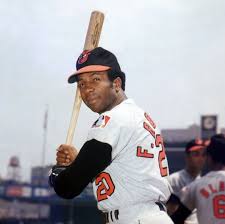
Frank Robinson 2/9/19
Hey baseball fans!
I don't usually do posts to honor a baseball personality after their death, but I'm making an exception here. Hank Aaron, Willie Mays, and Ernie Banks were some of the best sluggers of the 1950s, but there was an unsung hero who was flourishing just as much as them at the time and continued his success up until his final seasons. I am of course talking about the late Frank Robinson.
Robinson played for 21 years from 1956-1976 with the Reds, Orioles, Dodgers, Angels, and Indians. During his Hall of Fame career, he made 14 All Star Games and hit 30 or more home runs in eleven seasons. The 1956 NL Rookie of the Year Award recipient started off his career with Cincinnati, where he averaged 101 RBIs a season during his ten years there. His best season with the Reds was in 1961, when he won his first MVP award en route to leading Cinci to the World Series, collecting 37 home runs, 124 RBIs, a .323 batting average, and a league-leading slugging percentage of .611 during the regular season. In fact, 1961 was the second of three consecutive years that Robinson led the NL in slugging.
After the 1965 season, the Reds didn't feel Robinson's services were required anymore, considering he was "an old 30" at the time. So, he was traded to the Baltimore Orioles in December of 1965. Big mistake. Robinson would go on to win the Triple Crown in 1966, leading the American League in homers (49, a career high), RBIs (122), and batting average (.316). Robinson's heroic efforts landed him his second career MVP award, becoming the first player in MLB history to win the MVP in both leagues. However, unlike his 1961 Reds, who lost the World Series to the Yankees, his 1966 Orioles won the Fall Classic over the Dodgers in a clean sweep. Robinson also won the 1970 World Series, again with the O's.
In 1975, at the age of 39, Robinson became the first African-American manager in baseball history when he became the player-manager of the Indians. In his debut game, he penciled his name into the lineup card as a DH and then hit a home run! In addition to the Indians, he had stints as the manager of the Giants, Orioles, and Nationals.
Robinson retired from playing in 1976 and finished his career with incredible stats. Today, his 586 home runs rank tenth on the all-time list and his 1,812 RBIs rank 21st. He was elected into the Hall of Fame in 1982, his first year of eligibility, with 89.2% of the vote. Thank you, Frank, for all you provided for the game. You will be dearly missed.
Subscribe to:
Posts (Atom)


